Showing posts with label Research. Show all posts

Tuesday, November 8, 2016

Mentoring Failure

I love these conference connections!

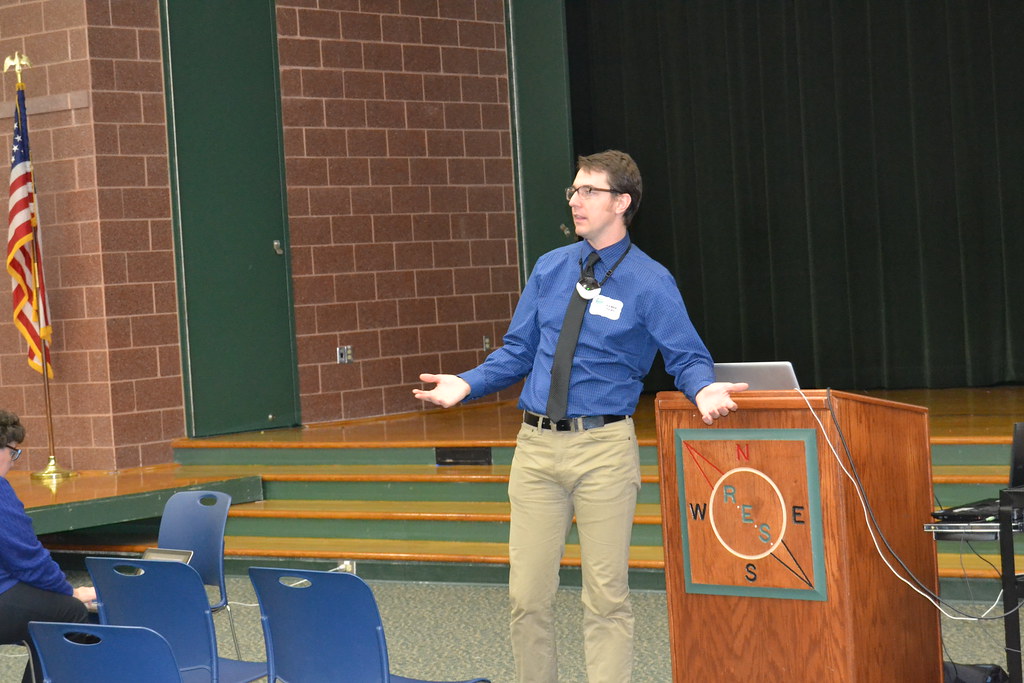
I am presenting at the Michigan Google Summit today at Lake Fenton High School on both teaching with TED-Ed and a session on mentoring passion.  I love the conversations that stem from my presentation on the work Christy Brennan and I did on our mentoring passion project, bringing together students of differing grade levels to share their inquiry experiences with one another.  In fact, I was hoping to scale this into a much larger project by putting together an online space to connect various teachers, students, and experts engaging in similar passion-driven inquiry projects across the country.  It was to be my TED-Ed Innovative Project.

But I failed.

Sharing my Mentoring Passion project with TED-Ed Innovative educators in June
I love this presentation, but so much of it is still in process.  It is not a finished project.  I am still reflecting on the role student ownership plays in the inquiry process. As I was presenting today, I revealed some of my pitfalls with my passion-driven inquiry projects and where I was still struggling. I need more time to reflect on where I am stepping into the student inquiry process.  I still spend too much time hunting down expert connections for my students, instead of facilitating opportunities to define and find those experts themselves. And as I shared, a conversation emerged that has me thinking more deeply about changes I want to make in the coming months to our inquiry projects.

Here is what I have learned: I need to open up more space in my classroom for students to talk about their failures. So much time is spent honoring the successes, the students who have done everything we have asked and have come to the conclusions that we expected them to have.  But what are they really learning?  Instead, I need to open up time and space for my students to share their struggles, like I did today, because the conversations that emerged from my admission of failure has moved me forward in my planning and thinking in important ways.  Imagine the power of those types of moments in our classroom.  Instead of teaching students to jump through hoops, we should be mentoring students on how to recover from initial failure.  This is a critical step in innovation. If we want to grow innovation in our classroom, we must open up spaces for failure.


Thursday, December 11, 2014

Connecting Passion

Just before Thanksgiving break, my tenth grade students opened up Blogger and started to design their first blogs. Well, now we are up and running.  Over the course of December and January, my students are using their blogs to connect with other students, supporters, and experts interested in learning with them as they explore an inquiry question they are passionate about. We call it our #HavPassion project.  Students have selected a wide range of topics to research, everything from how to refinish vintage furniture to how to prevent injuries while running. Interested in learning more about how we have conceptualized and organized our research? Here are the details of our inquiry project.

And we would love to connect with other students and classes also completing 20% time / project-based learning research! Below you will find images with links to our blogs. Hover over the image to learn more about our inquiry topics. Connect with us! Leave a link to your blog / class site in the comments section below.


Wednesday, December 3, 2014

Beginning Bloggers: Sharing our Research

Welcome to 2nd block.  This is my group of inspired researchers. They are learning about music production, about the perceived value of homework, about opening a bakery, and how to tell if someone is lying. And they would love to learn with you. You'll find their blogs connected in the image below. Please read, share, connect - learn with us!

WHAT IS #HAVPASSION ALL ABOUT?

The basic premise of our #HavPassion project is that it is student-driven, passion-based inquiry research. The idea behind this project started with Daniel Pink’s book Drive.  Pink, a former speech writer for Al Gore turned author, cites an idea that started with the 3M company and was expanded by Google. Google encourages its employees to spend one day each work week, 20 percent of their work time, focusing on their own projects. Why? It turns out that when people have autonomy over their work, time to master their skills, and a clear purpose, they are more motivated to learn. And scientific studies and research supports this claim. In fact, Google’s philosophy of 20 percent time is how we have Gmail!

DISCOVER  ★  QUESTION  ☆ REFLECT  ★  TRANSFORM

THE PROJECT:
What do you want to learn? Each Friday during the second quarter my students and I will be using our time to research the topic of our choice, an idea we are passionate about. Our goal is to become an expert on that topic. But this project is not just about researching…it is about doing something with what we learn. To complete this project successfully we will:
  1. Pick a topic we are truly passionate about, something we want to learn. Students may work alone or in small groups. Keep in mind what we learned about the origins of the word "passion." Passion is rooted in suffering; what is it that you are willing to suffer through, to push yourself to learn?
  2. Find a book to guide our learning.
  3. Pitch the project idea in a project proposal to the class for topic approval. Students will submit both a written proposal and produce a video proposal to be posted to our class site for our community of learners to vote on.
  4. Connect with an expert to interview.
  5. Blog each Friday reflecting on our progress. Each post should also incorporate reflections on how our selected mentor text is guiding our research.
  6. Produce something – a presentation, a writing piece, a show, something tangible – to share with people outside of our classroom.
  7. Reflect on what we have learned in a TED-style talk.
  8. Share all of our work on our online portfolio.
This is not simply a research project.  Once we’ve finished the research phase of this project, we must do something with our new found knowledge.  Students will be creating products and presentations (either individually or in small groups) that will extend beyond the classroom, such as documentary videos, web pages, pamphlets, newspaper or magazine editorials, an article for the school or local newspaper, letters, public speaking presentations, fund raising, music, plays…or whatever we can think of to best make our community aware of our research topic.  The idea is to reach an audience outside the doors of our classroom in order to share our research.  We will need to identify leaders in the field of our research in order to connect and engage with those thought leaders. 

Need some inspiration? Here you go!

Saturday, May 10, 2014

Researching Research

Image from GEPlan
I am researching research.  I know, it all sounds very meta.  But following my tenth grade English students' completion of our 20% time research projects, I wondered just how much of a difference, if any, this type of inquiry-based research writing assignment made for my practicing writers. And so I ended up undertaking a type of research that was quite similar to the research writing that I was studying from my students.  I completed a 20% research project on my students’ 20% research project!  Recently when I was interviewing my former students about their work, this is how we both discussed my own research.  And so I have had an opportunity to learn not only from my students as I interviewed and surveyed them, but also as I engaged in the very assignment I had asked them to complete. In recognizing this connection to my students’ work, I strived to replicate for myself many of the same activities that I asked my students to engage in as way of better understanding how I had asked my students to engage in their research process.  I needed to get inside both their research and mine.  To do that, I have been using this blog to share my reflections on what I have learned along with the resources I have gathered along the way in much the same way that I asked my students to blog about their research.  And because I asked my students to share their research and reflections as a presentation at the close of their work, I, too, wanted to share my research in this way. I was fortunate to be able to present recently at the Philadelphia School of the Future’s Educator Forum on May 3rd. And by the close of my presentation, I realized that my research is not yet complete.  Not only do I still have more to learn from my students, but I also learned that I need to revise my presentation to make sure that my students’ voices speak more about their process than I do.  So before I present this research again at the end of July in Chicago at the EdTech Teacher Summit, I plan to interview more of my students. I am interested in hearing more from my students about their writing experiences.

In designing both my survey questions and my interview questions, I was initially interested in learning more about what writing skills my students endorsed as those we developed through our more traditional research writing project versus those we developed through our more inquiry-based 20% research writing project. However, what I discovered from the student responses to both the survey and interview questions is that my students wanted to talk more about the structure of the assignment and what that did to encourage (and sometimes discourage) their engagement with writing and reflection. In the survey portion of my research, I asked students to review specific writing skills that our Pennsylvania Common Core State Standards outline as assessment anchors for expository writing and reflect on whether our traditional research essay writing assignment or our 20% research assignment better helped students practice these particular skills. In reviewing survey responses, I could see that there was quite a bit of diversity in their perceptions of what writing skills we were working to develop.  The only assessment anchors that were endorsed similarly by all students were the first criteria, “Analyze the interrelationships of ideas and events in a text to determine how one idea or event may interact and influence another”, which all those responding students indicated that our more traditional research addressed, and the last two anchors.  The last two criteria, both focused on the conventions and grammar of writing, pulled unanimous responses from the students who took the survey.  All students indicated that “Both types of writing assignments equally helped me learn this skill” to the last two criteria. So if both the traditional and more inquiry-based ways of structuring research writing assignments equally helped students develop skills with grammar and convention, what differentiated the assignments?

In reviewing the open-ended survey responses to the questions of “What did you learn about writing from your completion of the 20% time research project?” and the related question about our more traditional SSR research writing assignment, I noticed a striking difference.  Students nearly universally responded that what they learned from the traditional writing assignment was what we typically identify as writing conventions.  One student responded, “I’m horrible at doing works cited, so this project cleared up a lot of questions I had in regards to citing my work.” Another responded: “I was able to incorporate facts and other information to make an overall essay that was still interesting to the reader.” These typified the strengths students identified in the traditional research writing assignment, one in which their writing steps were prescribed and students were given an outline for how to organize their writing.  Students identified that they learned how to incorporate facts, fix sentence errors, and cite information. However, no student mentioned learning anything about the writing process or about the craft of writing in connection with completing the traditional research writing assignment.  However, students responded quite differently to questions about the strengths of the 20% project.

When asked about the strengths of completing our 20% research project, not only did students give more specific and detailed responses, but they also spent more time talking about their writing process, the decisions they made as to what to research, how to go about their research, as well as how to share their research.  Student responses were more focused on the process of their writing.  One student responded in the survey by stating that the 20% research project helped her understand that “Writing is so much more than just an essay.  This project gave me the opportunity to write (and post) blog-style pieces which turned out to be really fun.  Also, by creating a project proposal video, I was given the opportunity to make a presentation with more than just words and pictures (but actual creative animations) and to my surprise, I actually enjoyed making it.” In reviewing my students’ survey, interview responses, and reflective blog posts that they composed during their research process, students repeatedly referenced the importance of choice, purpose, and audience on their decision-making and composing processes.  Students wrote more about the choices they made both in the research process and rhetorically in the composing process based on sharing their work with a real audience.  During interviews, multiple students cited choice, mentors, audience, and reflection as significant motivating factors for how they wrote and shared their work.

In pulling together their survey and interview responses and reviewing the blog posts and digital compositions that students crafted during the completion of their 20% time research, seven themes emerged.  As I thought through how I wanted to share this research with others, I sought to find a way to distill those themes into an easily understood framework.  So after listing out my themes and thinking through the words that students used most often to describe their writing, I stumbled upon the idea of empowerment.  Students were not simply engaged in writing, they described feeling empowered by the process of research and inquiry when they had choice and ownership over it.  Using the word “empower” helped me frame my findings.  EMPOWER is an acronym for the seven elements of our research writing that students identified as being crucial elements in their success:
  • E - empowering choice
  • M - mentors as models for learning
  • P - process over product
  • O - ownership
  • W - wonder
  • E - enabling connections
  • R - reflection
Many of the elements that my students cited as being critical to their research process have also been cited by others.  Daniel Pink’s popular book Drive, focusing on what drives our motivation, also speaks to the power of choice, ownership, and the role that connecting with other learners plays in our motivation.  Additionally, writing teachers like Peter Elbow, Kelly Gallagher, and Penny Kittle have been publishing about the influence of purpose, audience, and reflection on the composing process for student writers.  So my research bears out some of what others have already published about how teachers can empower their students writers.  However, what I have found most interesting and what is leading me to do further research is why then isn't more inquiry and process-based research writing done in the English classroom, especially at the high school level?

In initially starting our 20% time research project this past fall, I sought the permission of my principal. This seems to highlight just how unusual this inquiry-based writing assignment is for the high school English classroom.  But clearly, it shouldn't be.  Inquiry-based or problem-based learning is not just for the hard sciences.  Humanities classrooms clearly can benefit from this approach as well.  Engaging in my own research on the research writing that I ask my students to do has encouraged me to reflect and re-envision how I structure and facilitate the writing opportunities in my high school English classroom.  Teaching writers is not about teaching the writing.  As Lucy Calkins' suggests in her book The Art of Teaching Writing, “[We] are teaching the writer and not the writing. Our decisions must be guided by ‘what might help this writer’ rather than ‘what might help this writing’” (228). Both by researching my students’ responses to this particular assignment as well as engaging in it myself has me gain a greater appreciation for the context in which writing happens in the classroom.

Saturday, March 1, 2014

What is Heutagogy?

I learned a new word just a few days ago: heutagogy. But before I explain what it means, I want to backtrack and explain how I learned about the idea of heutagogy.

My 10th grade students collaborating
My tenth grade students completed 20% time research projects during the fall semester. This was a change from the type of research they had completed in earlier classes in that I encouraged them to select topics they did not ordinarily have an opportunity to learn about in class, and we used at least (sometimes more) one full class day each week as a workshop day to research, read, interview, create, and revise their writing and their thinking. But it also meant that my students completed a lot of research in the fall. Not only did my students complete a 20% time project, but they also completed the more traditional research paper on an issue presented in a literary text that is currently mandated as part of our core curriculum. I sought permission from my principal to pilot this new approach to teaching research after completing a MOOC with A.J. Juliani this past summer. And as students completed their research, I was also starting my own, collecting examples of student work, watching how students engaged in the research process and used class time, reviewing the reflection blogs students posted about their process and what they were learning. Now that my students are established in their second semester classes, I have an opportunity to reflect on the process we engaged in and the skills students developed as they worked toward the completion of their self-selected and self-directed research. Having a bit of distance from the completion of their 20% time research project, I wonder what students will say about what and how they learned. Although I know why I feel such learning expereinces are valuable to their critical thinking and writing development, I need to hear from my students.

So this past week I had some information conversations with my former students. When I asked students what they thought about the 20% research project, four of the five students I spoke with responded that they like the opportunity to learn something that they usually did not get to study in school or that they liked being able to select their own topic without having to chose from a list. One of the students responded that he liked that he could learn in depth about a topic of his choice. Another student liked that she could choose the way in which she shared what she learned and with whom she shared it. So, the idea of choice has started to guide some of my initial research.

Graphic found on the NCSL's site
I started to look through some of the research on writing that I already had gathered. In trying to find published research on teachers doing 20%time/Genius Hour projects, I stumbled upon a recent blog post mentioned on Cybrary Man’s web resource for Genius Hour/ 20% Time. I was intrigued because he recently retitled this resource to included Self-Determined Learning. I have never heard of this before, although it seems evident. The blog post that prompted Cybrary Man’s page name change was a piece by the American School of Bombay Research and Development team and called for an end to Genius Hour and 20% Time Research projects. The reason? Such "projects" are relegating what many think of as the most meaningful work that we are doing in our classrooms to one hour or one class period a week, putting a box around this type of learning rather than thinking about what it means for our curriculums as a whole. I was intrigued by this idea. The post mentioned the work being done by Richard Ryans and Edward Deci on Self-Determined Learning (SDL). And within a few clicks and a quick perusal of Daniel Pink’s book Drive, I realized that I had already read a little bit of their work. Not only was Ryan and Deci’s work was mentioned in Drive, but their work is also being used to support a new movement - Heutagogy.

Click to view the larger size of Lindy McKeown Orwin's image at TeachThought
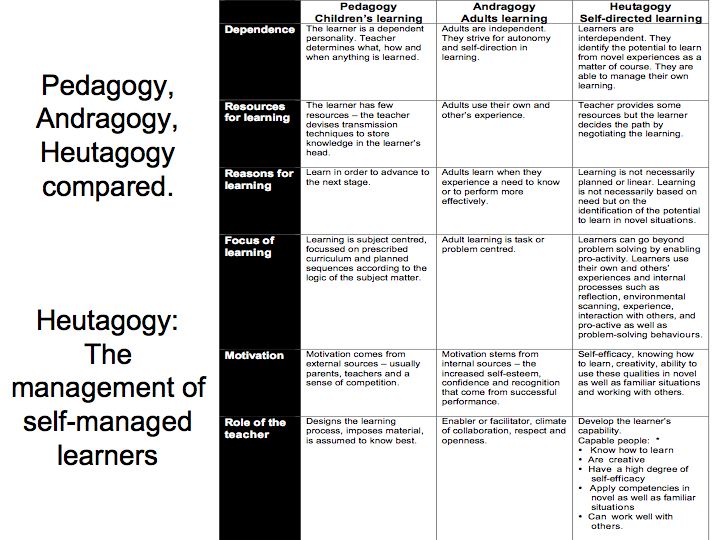
Heutagogy seems to have gotten its start in the 1970s by looking at what motivates adult learners, although initially this approach was called andragogy. Heutagogy is a evolution of some of that earlier research on what motivates learning, but heutagogy also includes an educational mandate. Instead of simply examining how people learn, heutagogy is also a focus on metacognition, getting students and teachers to think about how they learned what they learned. Hase and Kenyon are thought to be the originators of this approach, which they outline in a piece called “From Andragogy to Heutagogy”. This approach is also often called self-determined or self-driven learning. A quick search of #heutagogy on Twitter revealed that in the last month, more and more educators are starting to use this term and ideas of choice, autonomy, and mastery as they discuss successful learning and writing projects.

As I learn more about the tenets of heutagogy, I see this as being a framework for my research on my students' engagement in their 20% time research project.

I wonder if other educators are also using heutagogy in the development of their curriculum.  I would love to hear from you!


Friday, February 21, 2014

I Have It All Wrong...But I Have An Idea To Fix It

Graphic from SHSU
A few days ago, I posted a research idea  to investigate better ways of giving feedback to my student writers using digital tools.  The problem? I was going about it with my research end already in mind. I know from my work with students and from research already done by so many others what I would find: the students who are not as confident in their writing skills do not feel confident giving feedback on their peer's writing.  And the fix that I had in mind was that I would use the features of Google Docs to comment and give more feedback. But this is no different that what I am already doing!  Simply writing more on a student's writing piece is not going to necessarily ensure that they do something with that feedback.  It just makes more work for me as the teacher. I need a better idea for how to help students engage with meaningful revision of their written work.

Aaron Sams at PAECT event, Oct. 2013
Something I heard Aaron Sams talk about when I ate lunch with him at a PAECT event in October has been kicking around in the back of my mind.  A small group of us were discussing how we tackled grading issues when much of our planning time was used to created the resource materials that students use to learn our materials at home.  In the flipped learning approach, students learn from our instructional materials as homework while classtime is used to practice, collaborate, and workshop.  What this looks like in my high school English classroom can be a bit chaotic at times.  The big switch for me came when I asked students to complete their written work in class rather than in isolation at home.  This made a significant difference.  Students work on their writing with me in the classroom acting as their coach, they can ask questions of their peers, and they see models for how writing happens all around them.  But when do you grade all this work?  Aaron Sams' response: "I never take grading home."  WHHHAAAT??!!  Instead, he grades every assignment with the student in the classroom through a one-on-one conference.  Sounds awesome, right?  My first thought was, "Wow, I wish I could do that, but I don't have time enough in class."  After all, I'm and English teacher and Sams is a science teacher.  I just don't have time to conference every essay.

Wait!  Yes I do! So what I hoped to encourage was student engagement with the feedback they received on their written assignments.  Conferencing does this.  How many times on this blog have I mentioned the work of Lucy Calkins and Kelly Gallagher and Troy Hicks and the fantastic work done by all the National Writing Project educators, all of whom have shown again and again how conferencing with student writers not only helps the writer better understand her process and writing choices but also encourages a deeper level of reflection on where revision (not just editing) needs to happen.  And not only that, but conferencing with students while other students are in the room serves as a model for everyone on how we talk and think and support writing.  What would be a better use of our classtime? So I need to make time to conference/grade every essay in class.  And, I have an idea for how to do it.

Photo by Laurie Sullivan
My students are already using Google Docs and shared folders to turn in their essays.  The shared folder makes it easy for us to give feedback on each other's work throughout the drafting process since we can access each other's writing at any time either in school or outside of it. We use the comment feature in Google Docs to give written feedback. And as I handout the grading rubric the day a writing piece is assigned, we use the rubric to guide how we give peer feedback. But when it comes time to grade the essays, traditionally I have written all my feedback out on a printed grading rubric, not on the student's actual document.  Well, I'm going to change that up a bit, and here's how:

Audio recoding app in Google Drive
On the day that students are to turn in a completed writing piece, I'll call them up to the teacher's computer where I can already have the student's essay pulled up on my screen.  I'll have the grading rubric on my desk, and the student and I will use it to go over the writing piece together with the student making notes on the rubric as we discuss her piece.  There's a handy little tool in Chrome called Kaizena (formerly 121Writing).  When you are in Drive, click on "Create" and at the bottom of the options you will see "Connect More Apps."  Use the search box to find and install Kaizena.  What does it do?  It allows a user to record audio while looking at a specific Google document.  So, while the student and I are conferencing and collaborating over the grading rubric, I can record our conversation so that when the student goes back to her seat or goes home, she can access a recording of our conversation about her writing piece any time she wants!

Graphic from SHSU
Of course, there is no way that I will be able to conference with a class of 20-30 students in one 90-minute class period.  It will likely take three class periods.  However, as I'm conferencing, students can be using feedback to revise or make further edits or work on another piece.  Trust me, it took me a lot long than three days to get graded essays back to students using the model that I was working with. And the part that I am most excited about - not only will individual students have the ability to go back and listen to the audio record of our conference, but because their work is shared in a class Google folder, other students in the class could access the conference and learn from it as well.  I leave it up to the individual student on whether or not to leave the privacy setting open so others in the class can see and comment on their work, and surprisingly most leave their documents open for others to comment on. Using this conferencing model, I could end up with four or five essays from each student with audio conferences for each, and at the least that's 80 recorded conferences for students to use as models to improve their own writing.

There is some research being done on the effectiveness of using audio to record feedback for student writers.  Dr. Jeff Sommers at West Chester University has been publishing on this idea for the past couple years. His article in the Journal of College Literacy and Learning titled "Response 2.0: Commentary on Student Writing for the New Millenium" addresses how audio recordings can be a more effective feedback tool for student writers than the traditional written feedback.  So I am encouraged by this new model for grading student writing.

I am interested in how other teachers are using both conferences and digital tools to give student writers feedback.  Have you used audio tools to give your student writers revision suggestion?

Monday, February 17, 2014

Gimmie Feedback

Photo by Avolore
So with a bit of a stutter start due to a freak number of snow days this month, I've gone back to school. Full-time. My sabbatical this semester has me in three graduate courses, one being my required research methods course. Now, I just need to decide what I want to research. In the past, I've done action-research on mastery grading and written some about my interest in engaging student writers with authentic audiences. This time around, I want to spend time thinking about ways to grow stronger writers through feedback.

I’m hoping to conduct my research on student writing and ways in which I can help students better understand their own process of production and engage more deeply in their reflection and revision process. This is a topic that has been written about extensively by many others, and the works of Ralph Fletcher, Kelly Gallagher, Troy Hicks, Penny Kittle, and Nancie Atwell have certainly shaped how I interact with my student writers. However, I want to take some time to focus specifically on what is happening in my classroom, what I’m actually doing to teach and support my emerging writers, and reflect on my teaching strategies and assumptions of how my students learn their writing skills.

Photo by Mortsan
For the last seven or so years, I have almost exclusively taught tenth grade English at a suburban high school just outside of Philadelphia. With about 450 students per grade level at our high school, I usually end up teaching somewhere between 140-170 tenth graders each year, about a third of the grade level. I am generally teaching either honors level or academic level students, though those distinctions are often blurred as our district does not have true levelling system in that students with their parents self-select the level of the course they will take. My classes are diverse in that our district brings together students from a wide socio-economic range, and it is not unusual to have students who come from homes where both parents have advanced degrees and students whose parents did not attend college in the same class. That said, although our cultural diversity is increasing in the district, the majority of students identify as Caucasian, and I would guess that about 80% of my students started in the district as kindergarten students. As such, most of my students have come through a system that focuses on teaching the basic expository paragraph which culminates in writing essays formatted on the five-paragraph style of writing. However, as students get into their sophomore year, that formula for writing breaks down. Content teachers across our high school complain that student writing lacks analysis and critical thinking. So I have spent a great deal of time reflecting on how to teach writing that both encourages students to engage deeply with their content materials as well as reflect on how they are organizing their message.

In my classroom, I have moved away from writing on paper, finding that using online spaces to write, namely blogs and shared Google Docs, allow for greater feedback and for me to act more as a coach during the writing process rather than simply responding to student writing after the final copy has been turned in. I can give feedback as they write. When it is working well, students are not simply writing their own work, but engaged with their peers in a collaborative feedback process. This, however, has been difficult to manage. Generally speaking, the students that enjoy writing, who already write well coming into my classroom, are the same ones that spend the most time engaging with their writing and with the writing of their classmates. The students that need the most support are also those that rarely take time give to feedback to other students. This makes sense. The students comfortable and confident with their writing also feel comfortable helping others. However, the students that need more support, who would benefit from both giving and getting feedback, are those less likely to get it. And as a teacher of about 70 students each semester, I find it difficult to give feedback at multiple points to each student during their drafting process. So even though I know from research that students benefit from feedback during their writing process rather than after they complete it, I struggle to make that happen consistently for all students. This is where I would like to focus my research: How can I use digital tools to provide feedback on student writing that encourages revision and reflection on the writing process? And, how can I get all students involved in that process of feedback as well?

Here's where my research starts - with questions:
  • How do I get all students involved in the process of giving feedback to their peers?
  • Is it helping or hindering the giving of peer feedback that I do not grade peer feedback?
  • What types of feedback do students find most helpful during their writing process?
  • At what point in the writing process do students find feedback most helpful?
  • What inhibits students from giving feedback to their peer’s writing?
  • If my goal with feedback is to get students to go back into their writing to make content revisions and reflect on their writing process, should I grade student interaction with the feedback that I give?
  • How much is access is reliable wireless devices an issue?
  • How might the use of digital tools help the feedback/revision process become more transparent for both the student writer and the teacher?
As a National Writing Project (NWP) fellow, I am invested in students exploring their process of writing. In fact, on the very first day of each semester, the students and I begin by writing a short piece describing a metaphor for our writing process. How do we come up with and then refine our ideas through composition? I clearly approach the teaching of writing from a post-process approach, which means that I share with students, both explicitly and subtly, my understanding of writing as a non-linear process that is public, interpretive, and situated. My understanding of teaching writing influence by this post-process approach as well as by critical theories and is steeped in the writing of Alfie Kohn, Paulo Freire, Grant Wiggins, Allen Webb, and most recently by Troy Hicks, another NWP teacher who has focused his recent work on crafting digital writing with student writers.

And my own writing experiences have shaped how I teach writing. Many of my secondary school teachers and some of my undergraduate professors would share feedback in the form of one or two sentences and a grade at the end of my essays, which did little to encourage reflection on my own writing process. Yet, I was always writing, both for school and for pleasure. It really wasn't until I attend a small liberal arts college for my Masters in Liberal Arts that I began to reflect on how writing happens. My graduate professors gave extensive feedback not on my grammar or sentence construction, but on the content of my writing, talking back with me about how I constructed my ideas and rationales. And, our writing assignments were many times for larger audiences. We were sharing our essays with the other students in class, and many times we were submitting out for publication as well. It was in this program that I learned HTML code, not because I took a course but because I needed to create a website to share a few of my essays for a course on American women writers. And it was this experience of writing for a real audience that changed how I thought about my own writing and about teaching writing. When I started receiving emails from people who were reading my work online, I went back and made deliberate revisions (I even noticed this past week that one of my pieces was referenced in a book). And, I also sought out more opportunities to publish. I've been fortunate to have a couple of my poems published, my essay for This I Believe published, and of course I blog. So in teaching writing, I have sought many opportunities for students to write for larger audiences, not just for me as their teacher.

Photo from Flickr Creative Commons
Technology has made this increasingly easy to do. My students blog, submit for publication through websites and emails, and create their own web pages. And this has had an impact on what they select to write about and share. However, many students still seem to view the writing that they do for school as school writing, meaning it is only important insofar as the grade they receive. I don’t know if this is because students are used to using digital tools (Google Docs, blogs, etc.) to share their work and so the unique sense of an audience has disappeared for them or if perhaps they are so disempowered by the types of circumscribed writing that they have been asked to do that by the time I get them as tenth graders they don’t see the relevance of the writing we are doing. Maybe a combination of the two. But whatever the reason, my students do not seem to engage in reflection and revision as deeply as I would like to see them do.

So this is where my research into using digital tools to provide feedback to student writers begins. I hope to share with other teachers how using digital tools to give feedback makes the writing process more transparent for the students and the teacher and can grow student investment in building their writing skills. To this, my goal is not just interview my students, but students from a variety of schools and settings about how they engage with feedback on their writing. If you are interested in helping (or know someone who might be), reach out! I'd love to make new connections!

Friday, December 3, 2010

This Much I Know...

We began our conversation last night with two things we know for certain. Gathered around a conference table were our two PA Writing and Literature Institute instructors and five practicing teachers, myself included. We've each been pursuing our own teacher research on areas related to teaching writing. As I posted earlier, I'm looking into how the principles of mastery learning and grading might help to improve student writing. Specifically, I've been looking at how feedback on writing assessments differs between teachers who use a more traditional, cumulative grading system versus those who subscribe to the ideas of mastery learning.

We were inspired by Dorthy Allison's quote about her Aunt Dot:
"Lord, girl, there's only two or three things I know for sure." She put her head back, grinned, and made a small impatient noise. Her eyes glittered as bright as a sun reflecting off the scales of a cottonmouth's back. She spat once and shrugged. "Only two or three things. That's right," she said. "Of course it's never the same things, and I'm never as sure as I'd like to be."

So, here's what I know so far from my research:

Progress in student writing depends, in part, on doing something with feedback. If you've taken the time to grade a student's work, if you've written comments on it, or made suggestions for improvements, you must give students time to do something with that feedback. If you don't, you have wasted a great deal of your time grading the piece and wasted the student's time by asking them to write it. If you're not going to do something with the feedback, then don't give feedback.

This is not a new thought. A great many writers and teachers of writing have been saying this for years. But, it was interesting for me to see it echoed through the interviews and surveys that I've been doing with both teachers and students. Students admit to stuffing graded papers to the bottom of their backpacks with only a cursory glance at the percentage or letter grade at the top, and teachers admit to not giving time in class for students to read, reflect, respond, and revise based on the feedback they've given. And both teachers and students responded that they continued to see the same feedback time and time again. And no wonder. If a student doesn't have an opportunity to reflect and respond to a teacher's feedback about a his poorly written thesis statement, he's going to continue to write bad thesis statements.

What was most interesting to me about this is that many of the teachers I interviewed talked at length about times when they were able to really connect with a student and help that student make progress. Each example recounted a time when a teacher was able to help a student specifically identify a writing skill to work on, and then work with the student over time on various writing assignments to improve in that area. The student had multiple opportunities to receive focused feedback and respond to it, revising and reflecting on that skill area in order to make progress. Hmmm...isn't this working toward mastery? Identify specific skills, practice that skill, both teacher and student reflect on the student's progress, make adjustments, and repeat.

Which leads to the no-duh moment for me, the other thing I know for certain: our curriculums must clearly articulate the skills students are working toward and not simply the texts that they will read. In talking with teachers and in survey responses from teachers not just in my district but from all over the country, I have learned that many English teachers are simply picking for themselves the skills they will help students in their specific classes develop. One ninth grade teacher will choose to help her students develop clear organizational strategies in their writing, while the ninth grade teacher across the hall is working with his students on commas. And although both items are listed in the state's standards for writing, there is little consistency from class to class, let alone from year to year. I'm not suggesting that English teachers sit down to rewrite curriculums by creating page upon page of skill lists. But we need a starting point, a common ground and a common language. And by articulating the skills that we want our students to work on, we will help students develop as better writers overall, and not simply as better writers of literary analysis essays in response to a specific text.

Monday, December 14, 2009

Research Tools: Be the Spider

Cross posted at: http://wardsworld.pbworks.com/Better-Researching

Be the spider, not the bee
When looking for food, the bee travels from flower to flower to flower. This is the traditional way that we think about researching. We go to a search engine and jump from web page to web page to web page. This is tiring and inefficient. Instead, we need to be like the spider.

The spider spins a web and waits for his food to come to him. He doesn't waste time. He has found a better way to make what he wants come to him. So, how can we do that as researchers?

BEE A Better Searcher: Google Smarter, Not Harder


Using Better Search Terms and Options
WHAT TO PUT IN THE SEARCH BOX: Use this handout
  • It's all about your search terms. Before ever putting a word into the Google search box, first spend some time coming up with 5 - 10 specific search terms. In fact, refer to these pages to help you refine your search terms.

  • Use quotation marks to limit results. Putting quotation marks around your search terms tells Google to return results that include only that exact phrase. This is especially important to use when you are looking for research on uniquely worded or specific terms. For example, there are over 16 million results for India's water supply but only 186,000 results for "India's water supply," and the results that are returned when using the quotations are more relevant.

  • Search within a specific website (site:) Google allows you to specify that your search results must come from a given website. For example, by typing India site:nytimes.com Google will return pages about India from the New York Times website. You can broaden this, too. If you type India site:.gov, you will get results from a .gov domain.

  • Use the minus to limit what your search returns. When you put a minus before a word in the search box, Google will not return sites that include that term. For example, by doing a search like salsa -dancing (notice there is no space between the minus and dancing), the minus will remove "dancing" from the search results you get back.

  • Define: Need a quick definition? Type define: word and viola! An instant definition!

  • Use OR to refine your search. Google's default behavior is to consider all the words in a search. In fact, you don't need to use and because this is Google's default. If you want to specifically allow either one of several words, you can use the OR operator (note that you have to type 'OR' in ALL CAPS). For example, Philadelphia Phillies 2008 OR 2009 will give you results about either one of these years, whereas Philadelphia Phillies 2008 2009 (without the OR) will show pages that include both years on the same page.

  • Use the tilde to find synonymous search terms. Adding the tilde (~) before a search term will help broaden your search because the tilde tells Google to return not only the search term you specified, but also terms that Google thinks are synonymous with your term.

  • Use an asterisk to find a quick answer. Sometimes the best way to ask a question is to get Google to fill in the blank by adding an asterisk (*) at the part of the sentence or question that you want finished into the Google search box. How many MPH can the world's fastest man run? Ask Google by typing the world's fast man can run * MPH.

USING THE ADVANCED SEARCH:


GOOGLE SEARCH OPTIONS: Search smarter using timeline searches, scholar searches, and book searches

  • Google Books: Search full texts of books (hint: use the search box to the left of the book's pages)

  • Google Scholar: Search scholarly online journals, presentations, and texts

  • Google News: Search worldwide news sources

Tips and Tricks for Searching Sources Faster
  • Control + F opens a find box at the bottom of the page to make searching within a document for specific information even easier. This works on any web page.

  • Search a specific site by using site:

  • site:wardsworld.pbworks.com Kite Runner will return pages on my site that mention Kite Runner

  • site:.edu India water shortage will search educational sites for mention of India's water shortage issues

  • filetype:.pdf (or .doc or .ppt, etc.) will help you find specific file types (this can also be done from the advanced search

How Do I Know I Have Reliable Source?
RESEARCH TIPS:
1) Always check your work: validate the information by looking at multiple sources
2) Credibility =trustworthiness + expertise Strategies to determine trustworthiness and expertise:
  • Check the "About" section - look at who is publishing the site, the author's credentials, sponsoring organization, citations to other works. Use this to assess the bias.

  • The URL - is the web site from an organization you've hear of?

  • Type of page - is it someone's personal page?

  • Type of domain - .edu sites are generally more believable than some others

  • Where - is the site hosted in another country?

  • Is there a date and an author?

  • Do others cite this source? Use link: to see what links to a website
Information from this presentation

Make the WEB Work Harder:
Google Alerts
  • Create Alerts to send relevant news resources to your email inbox. BE THE SPIDER!


Access Your WEB of Research Anywhere:
Online Bookmarking


Monday, January 21, 2008

Research Matters -or- Making Research Matter

The ubiquitous research project can be a daunting process for students and teachers alike. A requirement in most English departments, the research process is often taught as a stand-alone unit, stiff and formalized, with no clear connection to other materials in the curriculum, let alone to real-world applications. The traditional research unit tends to spend a great deal of time emphasizing discrete skills: thesis writing, creating note cards, outlining, and using persuasive rhetoric. While these skills are helpful for students to know and understand, lost somewhere in the mix are the equally if not more important skills of creative and critical questioning, along with the practical application of research.

It’s time to step back and re-envision what research can be – a fruitful avenue for teaching students the purpose of research, namely, affecting change. Research can be a form of authentic assessment, with students engaged in both their local community as well as their larger global community. Research can be a way for students to look more closely and critically at issues facing their world, act on their research in hopes of bringing about a positive change, and share their research using a variety of writing styles.

By incorporating the principles of formative and authentic assessment, I've changed how I teach research skills to my tenth grade high school students. When introducing our research unit, I no longer start with what it is that the students will produce. Instead we start with a discussion about why research is done. The guiding premise of my research project is simple: research is done to effect change. By starting with this premise, students not only understand the value of research but also begin to understand themselves as researchers.

In the last three years I've moved from teaching a traditional research unit to making research something that we engage in throughout the course; after all, the principles of research are the same principles that we want students to incorporate and use in a variety of contexts. Whether we are talking about a novel or writing an essay, students should be evaluating and analyzing a text for its bias and meaning in order to form critical interpretations and original responses. These are the very same goals we have for teaching research. So moving research out of a "unit" and integrating it into the foundation of the course makes absolute sense.


Making Research Authentic
Today's students communicate with people all over the globe through use of instant message services, social networks, blogs, and forum sites, so finding an audience for our students' work outside the walls of our own classrooms is much easier than it was even five years ago. However, finding ways for students to present their research and writing to an authentic audience is only part of what makes an assignment a form of authentic assessment. In the world outside the walls of our classrooms, scientists and writers alike choose their subjects. Not only do they hypothesize where their subjects (whether an experiment or a character) will go, but they also test and retest their subjects. They consult colleagues and outside experts, and they revise their work before it is ever published. And even after it is published, scientists and writers continue to work with their subjects. So as much as possible, it is important to adopt this process inside the classroom.

As I've revised my research project, I've done away with the list of potential topics. The students and I both found it stifling. Instead, as we talk about the purpose of research, we also talk about who does research. Research is done by educators and doctors. It is done by writers, anthropologists, historians, musicians, environmentalists, and artists. So when they are given the rather large perimeter of finding a research topic about an issue currently affecting the culture where their pen pal lives, they come up with a wide variety of topics that interest them. This semester, when their pen pals were from Morocco, Liberia, and India, they came up with a number of unique research topics based on their personal interests. I had projects on everything from the prejudice Muslim women experience as a result of religious dress to the reliability of charitable organizations operating in Liberia. Students researched the loss of traditional storytelling in Morocco and the current plight of Untouchables in India. They chose topics that interested them, and as a result, they were invested in the process of researching.

Additionally, one of the requirements of my research project is to take the research outside the walls of our classroom. Students have to find a way to present their research to a targeted audience. This year some students worked together to put on a Cultures Fair for our school and community which raised money to help educate children in needy areas, while other students prepared lesson plans and taught their research to various middle school and elementary classrooms. I had students that created web pages and wrote letters to our local newspaper editors. I had students coming into class excited each day when ten new people had signed onto their Facebook group about aiding former Liberian child soldiers. And, you should have seen the students’ excitement when they started to have students from other schools reply to their groups. My students came into class talking about how a student from another local school posted a response to the group on helping those in Liberia who suffer from AIDS. A student from India responded to the Facebook group about Moroccan women’s access to education. My students used their research to raise awareness not only within their school and their community, but within the world. And isn’t that what research should do?

Utilizing Formative Assessment Techniques
More and more we see "formative assessment" (also known as assessment for learning) cropping up in educational journals along with discussion of differentiated instruction and multiple intelligences. The premise of formative assessment is that students have an opportunity to question, interact, practice, and reflect on the material being taught before use of any summative assessments. Formative assessment hinges on the student and teacher working together to help the student self-assess his or her learning. Students have an opportunity to practice a skill before they are tested on it. Teachers use informal assessment to adjust what and how they are teaching. So before a student has his paper cut to shreds by the teacher's red pen, both he and the teacher have feedback on exactly what he needs to work on before anything receives a formal grade. The student has an opportunity to master a skill. Such practices making teaching about learning rather than about grading.

Incorporating formative assessment into teaching research is a simple process. All I had to do was stop slapping a letter on every essay. Honestly, formative assessment was a relief. I could read a draft of an outline without having to keep a rubric or a score sheet handy. Instead, I read the students' work. After reading an essay, I would write a couple of targeted comments at the end, giving each student specific feedback on where he or she should spend time revising. I wrote questions at the end of each draft to help students reflect on the assumptions they made in their arguments. I used comment-only grading to help differentiate how I teach writing. Formative assessment practices helped me be a more effective writing teacher. It also helped the students become better at peer and self revision. When they weren't looking for the grade at the top of the draft, they focused on the comments, and then applied this technique to their peer and self revision. The students spent more time thinking about their writing, and isn't this what all writing teachers want to see?

The Cultures Project
I still make adjustments following each semester, reflecting on what worked and what did not. This past semester I spent more time on thinking about the comments that I made on each student's draft, making sure to write some of my comments in the form of questions. Next semester, I'll have the students keep all their written drafts in a file in the class room along with a log of when they turned in various drafts. In the past, I kept track of all of this information, a logistical nightmare. However, part of using formative assessment is giving the classroom back to the students. The more they have ownership of their research, the more they are invested in the project as a whole. The more the students have ownership of the classroom, the more they are invested in their learning. My goal is to be the facilitator that helps the students navigate the learning process. Together, we are both active learners in the classroom.

I've posted the project handout on my classroom website, and it is also attached HERE. Please feel free to adapt and use it if you are interested, and let me know how it goes!

Related Posts: