Wednesday, March 5, 2014

I Write Therefore...

Slice of Life Challenge, Day 5
Years ago, I typed out and taped a quote from one of my favorite books, Annie Dillard's The Writing Life, to the top of my desktop monitor: "How we spend our days is, of course, how we spend our lives. What we do with this hour, and that one, is what we are doing." Today, I am a writer.

I have spent my entire day writing.  Actually, it would be more accurate to say that I have spent my entire day rewriting.  The last 14 hours...oh dear, seriously, that long??!?!...have been spent revising two pieces that I have due for one of my graduate classes tomorrow night.  I must confess that I don't know that I ever spent quite this much time on an essay for undergrad.  Wait.  Maybe once.  I had this essay due my sophomore year for a notoriously difficult poetry teacher (rumor was he was only allowed to teach required courses because he gave so few passing grades) comparing the poems of Dylan Thomas from different periods of Thomas's writing career.  I wrote that darn paper three times.  Once because had failed to save and lost the entire piece when I went to print from my word processor (yup, I am that old), and the second time because I accidentally deleted the darned essay after getting three quarters of the way through writing it. By four in the morning, the essay was finally completed, and I knew the work of Dylan Thomas better than any Ph.D. candidate on campus, having had to rewrite that *expletive* *expletive* *expletive* essay so many *expletive* times.

But today's work was different.

In my earlier undergrad and graduate programs, I have done well.  I am not someone who has struggled with writing or with school work.  I like school.  I like writing.  But, I have never put a lot of time into what I have done, usually waiting until the last possible moment to put writing pieces together, knowing that the writing would come.  Lately, however, this has not been the case.  I struggle over my words, rewriting them time and again.  This is not an exercise.  This is what I am doing.  My words matter.  I am a writer.

Weird.

I don't have a book.  I haven't published in print anywhere recently.  But this is what I consider to be my life's work.  Writing.  Helping other writers discover their voice.  In doing so, better understanding my own voice.

It feels hesitant and awkward to proclaim that I am a writer. I am shy about this. But not apologetic.

I am a writer.

Annie Dillard wrote, "One of the few things I know about writing is this: spend it all, shoot it, play it, lose it, all, right away, every time. Do not hoard what seems good for a later place in the book, or for another book; give it, give it all, give it now. The impulse to save something good for a better place later is the signal to spend it now. Something more will arise for later, something better. These things fill from behind, from beneath, like well water. Similarly, the impulse to keep to yourself what you have learned is not only shameful, it is destructive. Anything you do not give freely and abundantly becomes lost to you. You open your safe and find ashes."

And so, I will continue to write, to obsess over my words, to give freely as to not become lost.

Tuesday, March 4, 2014

A Student's Life

Slice of Life Challenge, Day 4

As I sit here typing, my son is reclining on the couch, his V-Tech "laptop" balanced on his belly, stablized by his criss-crossed legs. He's working on math problems. "I'm doing my homework," he's declared.  Just like mom.

I've flipped roles this semester.  My sabbatical began a little over a month ago, opening up the opportunity for me to return to school full-time.  And so my Tuesday and Thursday mornings and early afternoons are spent with my nose buried in books on rhetoric and teaching writing and literary theory and research.  And when my boys return from preschool, those books are generally strewn across the dining room table, intermixed with their Lego mini-figures in awkward poses, while I'm typing up my reading notes or a literary analysis essay.  This is my homework.  And I love it!  I've been writing and reading more than I have traditionally had time to do at this point in the year.  I'm enjoying being a student.  And it comes at the same time that my son is figuring out just what that means - being a student.

On Thursday this week, I'll stand in line to register him for kindergarten next fall.  He knows this.  He has been speaking of himself in future. "I'm going to be a student. I'm going to have homework." He's excited about this. He wants to learn.  He's been practicing homework, grabbing a sheet of printer paper and a colored pencil to practice writing out his letters while I type up my essays for class. It has me wondering about the years in between kindergarten and grad school, when so many students disengage from learning. What are the experiences that suck the the joy out of learning?  When does homework become less about learning and more about work?

Digital Rhetoric

My first website
I am a geek.  In 1998 the professor of my American Women Writers course announced that our final course project could be submitted in a creative format and flippantly gave the suggestion of creating a web page.  My ears perked up.  A web page?  How hard could that be?  So I signed up for a free Geocities account and sat down to learn HTML programming code. What can I say?  I enjoy a puzzle, and that’s exactly what designing my first website was for me - a puzzle.  I researched other sites, looked at the placement of text and images, learned the code to add in backgrounds, lists, and most importantly to add in hyperlinks, and hit publish.  It likely took me three or four times as long as my fellow graduate students, many of whom put together traditional literary analysis essays or lesson plans, to complete both the design and the writing that went along with my project, but I can now point to that moment as the start of something significant.  As I worked on that first site, I not only wrote and revised a traditional essay, utilizing what some might think of as the more traditional rhetoric and composition skills, but I also had to reflect on how my medium affected my message.  Taking into consideration who my anticipated reader was and how that reader would engage with my website, I made revisions to the images that I used, the introductory message, the organization of my pages and ideas.  I was forced to think critically about my audience and about my purpose.  And in making those considerations about the digital components, I also went back and revised my composition while keeping in mind my audience and purpose.  My medium informed my message.

Bringing digital writing into our classrooms opens up new opportunities for students to write and engage with authentic readers.  As teachers we can guide our students to think critically about the choices made by the authors of digital texts.  We can address a variety of learning styles through the use of digital texts, meeting the needs of verbal, visual, and aural learners. Through careful selection of digital mentor texts by teachers, students use digital models to help them craft and produce writing for real audiences in ways that engage readers outside the walls of the classroom.  Digital writing extends our learning about rhetorical choices. Technology opens up a world of writing possibilities.

And our classrooms are filled with technology.  The smartphone in the hoodie pocket of my student sitting in the front row of class has more memory than my first computer. Students are eager to use technology to learn both inside and outside of our classrooms.  Yet, perhaps the most commonly voiced frustration about incorporating technology into instruction is “I don’t have time.” I don’t have time to add in another thing to my already packed curriculum.  I don’t have time to learn Screencast-o-matic, and then teach it to my students.  Technology should not be an addition to what we are already doing to teach rhetoric and composition. Instead, digital tools help us engage students more deeply and critically in their examination and creation of texts.  It is not an addition; it is a refocusing.  As Mary Hocks writes in her article "Understanding Visual Rhetoric in Digital Writing Environments" published over a decade ago in the journal College Composition and Communication, “I believe that teaching digital rhetoric requires profound changes in how all of us think about both writing and pedagogy: Critiquing and producing writing in digital environments actually offers a welcome return to rhetorical principles and an important new pedagogy of writing as design” (632).

Hocks outlines how digital texts, more so than linearly printed texts, offer opportunities for the readers to more readily examine their stance as an audience for the reading.  She states, “Audience stance describes how the work visually gives the readers a sense of agency and possibilities for interactive involvement” (635). We take this for granted in printed texts.  Similarly, the ideas of transparency and hybridity, as shown through her example texts, demonstrate how use of digital texts can call student readers and writers to examine rhetorical choices that are often overlooked or taken for granted in traditional print writing. As such, Hocks asserts that through the critique of digital texts, students are more readily able to examine the rhetorical stance of the author/creator. It is through use of visual rhetoric in addition to more traditional textual critique that students have opportunities to engage more deeply in the critical examination of text production. Using these digital texts as models for their own work, students move from simply being consumers of knowledge to designers of it, and as such engage in those higher-order thinking activities teachers strive to facilitate.

But technology can be daunting for the uninitiated teacher and student.  Yet as Hocks’ essay points out, it’s not really about the tech.  Her focus, like ours as writers and teachers of writing, is on the craft and critical thinking that goes into writing and the production of meaning. Her essay does not delve into how to move images on a website or how to code.  Yet this is often what will shut educators down from attempting to use or create digital texts - the fear of tech.  How do we help those new to reading and creating digital spaces understand that it is not an additional app that we need to learn/teach but a changing set of rhetorical skills?

Monday, March 3, 2014

Read to Me

Slice of Life Challenge, Day 3

Students across the country are celebrating Read Across America Day today, that is if they are not enjoying yet another snow day. The National Education Association established Read Across America Day to coincide with Dr. Seuss's birthday on March 2nd. Because of our snow day today, my boys will celebrate tomorrow by bringing their favorite books to preschool and making Cat in the Hat crafts to wear throughout the day as they share their favorite stories. My eldest son has had his book picked out for a while. The Lorax. "Dr. Seuss makes a lot of rhymes, and I make a lot of rhymes, so we're kinda twins," he declares. He loves being read to, and as he is starting to pick out a few words on his own, I know it won't be all that long before he's reading on his own. Two of his very favorite spots are the library and the bookstore.  And both his dad and I are happy to indulge frequent visits as these are some of our favorite spots as well.

My son makes a Lorax mustache with his fingers
Sadly, though, this isn't a common experience for many of our young readers.  A poll released by the Pew Research Center in January of this year states that just under a quarter of Americans did not crack a book at all last year. The average number of books read by an adult last year? Five.  That's it.  But before we throw our hands up in frustration, we need to take some time to think critically about the types of reading experiences that our young people are offered today.

My tenth grade students, as I mentioned in a post a few days ago, take the PSATs, three state exams (some will take these state tests twice in one school year), and a few will end the year taking AP tests.  Not only is that a great deal of testing, but think about the reading that students engage in as they hunker down and bubble in responses.  Short, passage-based reading.  And to prepare for these tests, students are often given short, passage-based reading.  How much time do we give to our students to select a book of their choice and read for pleasure?  No wonder fewer adults escaped into a good book last year.

Not only do our students need more opportunities to read books of their choosing while they are in the classroom, but they also need to see their teachers reading for pleasure.  They need to see principals, staff, parents, and peers reading for pleasure.  We need to establish reading communities across the content areas.  Choice over what to read should not be relegated to the one Self Selected Reading (SSR) project done in the English class once a year.

And, as Philly teacher Mary Beth Hertz pointed out a few weeks ago in her Edutopia blog post titled "Reading 2.0," all hope is not lost.  Instead, we not only need to open up opportunities for students to select their own books, but we also need to include the reading that they do engage in, which for many of our students is done digitally.  Hertz writes,
"If we're forcing students to read boring test passages over and over, and teaching them that the only purpose behind reading is to perform on a test, then we have only ourselves to blame if students aren't reading for pleasure. We also need to begin to accept new forms of reading as what they are . . . reading. Young people have more reading options today than ever before, and these forms of reading require them to read differently."
Often times teachers scoff at the idea of labeling fan-fiction as reading.  However, it is a similar arguement that many had a decade or so ago when graphic novels started to become popular in middle and high school curriculums.  Students are reading these creative texts. Students are writing these creative texts.  Young people come into my classroom surprised sometimes when I do not scold them for reading an e-book on their phone.  Why would I?  The student is reading!  What more could an English teacher ask for?  We need to start bringing digital texts, not just e-books, but blogs, fan-fiction, and social media sites into the classroom.  Let's help our students learn to read these texts critically. And let's start counting all the reading that they are doing.

Sunday, March 2, 2014

Open to Adventure

Slice of Life Challenge, Day 2

Most days, my boys are up for anything.  This morning following breakfast, I grabbed my cup of coffee and my tablet and flopped down on the couch while my boys played with their Legos to engage in one of my too often indulged in guilty pleasures...Pinterest. And what should appear on my screen? Pages of Ethiopian recipes. I still remember my first visit to an Ethiopian restaurant while staying with friends in Washington D.C.  My taste buds lit up.  So this morning, when I announced to my little Lego designers that we were headed into the city to buy some ingera and spices for an Ethiopian-inspired dinner, they gave me a quizzical look and went on playing with their Legos as if to say, "Okay, Mom. Whatever you say." An hour later, they were entertaining the young shop clerk while they begged to try the mango hard candies and samosas we also purchased. They were open to today's adventure.

My three-year-old is interested in all things edible. I'm lucky in that he'll eat nearly everything I've put in front of him (though last night's pickled herring took a little bit of convincing until my husband called it "Viking food"), but he also wants to help in the kitchen in the preparation of every meal.  So tonight as I had three pots on the stove, a mess of bowls in the sink, and a cutting board full carrots, my first inclination was to shoo him out of the kitchen so I could have dinner on the table in time.  But when he looked up with those eyes and said, "No mommy. Me help you," how could I say no?  He dragged his little chair over to the counter, climbed up, and I handed him a whisk.  And when our Ethiopian meal made it to the table, not only was he excited to be able to eat with his hands, but he was also excited to point out to his older brother and dad what he made - a salad.  He whisked the dressing and mixed it with the cucumbers and tomatoes. His eyes shone.

I need to remember to also release control of my classroom and give students more moments to shine. Having autonomy of one's learning is not just motivating, as Daniel Pink and others have pointed out.  It is empowering. I want to work with empowered students, empowered students open to adventure.

Saturday, March 1, 2014

Measuring Up

I have followed the Two Writing Teachers blog and their Slice of Life writing challenges for over a year, but I have never participated. Until now. Today is the first day of the 2014 Slice of Life Writing Challenge. So, what is the challenge? Write about a slice of your day for each day in March. In addition to these daily posts, participants are encouraged to comment on at least three other #SOL14 posts, giving us a chance to get to know other bloggers. So here goes my first post:

This morning, as my boys were getting dressed, pants half pulled on and pajamas strewn across their shared bedroom, my five year old son became excited to see how he "measured up."  A wooden growth chart hangs near their bedroom door, and each birthday we mark how much my two sons have grown, taking time to pause and remember all that's happened in that year. It's a simple chart, marking dates and heights, but when my son wanted to stand in front of it this morning, heels tight to the wall, palm skimming the top of his head, a little sadness caught in my throat.  Not a nostalgic sadness that wished for time to slow down, but a sadness to see how concerned he was that he was measuring up.  And I wondered how much I was responsible for this concern.

As many first-time parents do, I anxiously read all the books and blog posts.  Was he reaching his milestones at the correct time?  Did he have enough words in his vocabulary? Shouldn't he be walking by now? I measured him in so many different ways.  Had I passed this concern onto my son?  Would he always be looking for where he should be instead of enjoying where he is at?

And as a teacher, isn't this similar to what I do with my students: grades assigned to essays or tests perhaps before students have quite reached their full potential.  Some students need more time to grow, to learn and practice the skills we expect them to demonstrate.  Others will have their growth spurts early, charging ahead of their classmates for a time.  But learning shouldn't be about the race to see who measures up the fastest.  But with an increased focus on high-stakes test scores, it seems that this is all we are concerned with - how fast and how well do our students measure up.  My tenth grade students acutely feel this measuring. As sophomores, many of my students sign-up for weekend SAT prep courses or work with tutors, and take the PSATs, and take our state standardized tests in English, biology, and algebra, and then end the year in grueling AP tests.  At so many different points they are tested; their scores measured against those of neighboring districts and districts across the state.  We talk of students as groups, as numbers.  But what about the individual?

That's what caused tears to catch at the corners of my eyes this morning as I saw my five-year-old trying to measure up.  Next fall when he enters kindergarten, I hope his teacher doesn't just see how well he does on a vocabulary test or how well he knows his b's from his d's.  I hope his teacher gets to know my joke-tellin', rhyme-lovin', puzzle-solvin', song-singin' little boy. And more than that, I hope that his teacher encourages him to be creative, to explore, to listen to the world around him, to get to know his classmates, and to not worry so much about whether he measures up. I, too, need to remember this for all the students who find their way through my classroom door.

What is Heutagogy?

I learned a new word just a few days ago: heutagogy. But before I explain what it means, I want to backtrack and explain how I learned about the idea of heutagogy.

My 10th grade students collaborating
My tenth grade students completed 20% time research projects during the fall semester. This was a change from the type of research they had completed in earlier classes in that I encouraged them to select topics they did not ordinarily have an opportunity to learn about in class, and we used at least (sometimes more) one full class day each week as a workshop day to research, read, interview, create, and revise their writing and their thinking. But it also meant that my students completed a lot of research in the fall. Not only did my students complete a 20% time project, but they also completed the more traditional research paper on an issue presented in a literary text that is currently mandated as part of our core curriculum. I sought permission from my principal to pilot this new approach to teaching research after completing a MOOC with A.J. Juliani this past summer. And as students completed their research, I was also starting my own, collecting examples of student work, watching how students engaged in the research process and used class time, reviewing the reflection blogs students posted about their process and what they were learning. Now that my students are established in their second semester classes, I have an opportunity to reflect on the process we engaged in and the skills students developed as they worked toward the completion of their self-selected and self-directed research. Having a bit of distance from the completion of their 20% time research project, I wonder what students will say about what and how they learned. Although I know why I feel such learning expereinces are valuable to their critical thinking and writing development, I need to hear from my students.

So this past week I had some information conversations with my former students. When I asked students what they thought about the 20% research project, four of the five students I spoke with responded that they like the opportunity to learn something that they usually did not get to study in school or that they liked being able to select their own topic without having to chose from a list. One of the students responded that he liked that he could learn in depth about a topic of his choice. Another student liked that she could choose the way in which she shared what she learned and with whom she shared it. So, the idea of choice has started to guide some of my initial research.

Graphic found on the NCSL's site
I started to look through some of the research on writing that I already had gathered. In trying to find published research on teachers doing 20%time/Genius Hour projects, I stumbled upon a recent blog post mentioned on Cybrary Man’s web resource for Genius Hour/ 20% Time. I was intrigued because he recently retitled this resource to included Self-Determined Learning. I have never heard of this before, although it seems evident. The blog post that prompted Cybrary Man’s page name change was a piece by the American School of Bombay Research and Development team and called for an end to Genius Hour and 20% Time Research projects. The reason? Such "projects" are relegating what many think of as the most meaningful work that we are doing in our classrooms to one hour or one class period a week, putting a box around this type of learning rather than thinking about what it means for our curriculums as a whole. I was intrigued by this idea. The post mentioned the work being done by Richard Ryans and Edward Deci on Self-Determined Learning (SDL). And within a few clicks and a quick perusal of Daniel Pink’s book Drive, I realized that I had already read a little bit of their work. Not only was Ryan and Deci’s work was mentioned in Drive, but their work is also being used to support a new movement - Heutagogy.

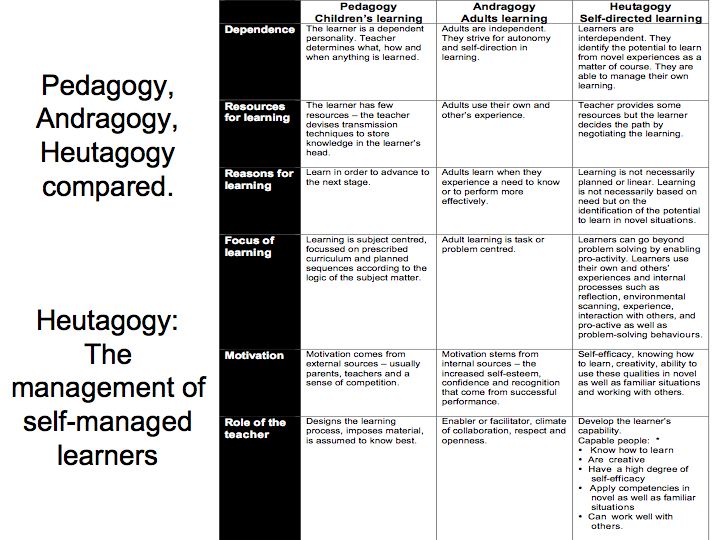
Click to view the larger size of Lindy McKeown Orwin's image at TeachThought
Heutagogy seems to have gotten its start in the 1970s by looking at what motivates adult learners, although initially this approach was called andragogy. Heutagogy is a evolution of some of that earlier research on what motivates learning, but heutagogy also includes an educational mandate. Instead of simply examining how people learn, heutagogy is also a focus on metacognition, getting students and teachers to think about how they learned what they learned. Hase and Kenyon are thought to be the originators of this approach, which they outline in a piece called “From Andragogy to Heutagogy”. This approach is also often called self-determined or self-driven learning. A quick search of #heutagogy on Twitter revealed that in the last month, more and more educators are starting to use this term and ideas of choice, autonomy, and mastery as they discuss successful learning and writing projects.

As I learn more about the tenets of heutagogy, I see this as being a framework for my research on my students' engagement in their 20% time research project.

I wonder if other educators are also using heutagogy in the development of their curriculum.  I would love to hear from you!


Related Posts: