Monday, December 10, 2007

Typewriter vs. Blackberry

I am a digital immigrant. I remember typing my first high school essay on a typewriter, plunking down each key hard enough so the ink would leave its indelible mark on the bright white page. My ninth grade science teacher returned my essay on chlorofluorocarbons filled with red ink and asked me to revise the piece. I remember dreading the process of retyping the essay, my fingers slipping between the keys when I would miss the letter and having to dig through my mother’s desk drawer for the white-out because our typewriter did not have a correction ribbon. It was 1994 when I got my first PC; it had 386k of RAM.

In fifteen years, we’ve gone from typewriters to being able to type messages into phones, from white-out to auto-correct. In those fifteen years, the face of public education has changed dramatically as well. Teachers are not simply finding new ways to integrate technology into their classrooms, but are also rethinking how and what we teach. Today’s classrooms look very different than those of fifteen years ago or from those just five years ago.

Take for example my classroom. Five years ago I was teaching ninth grade English courses and an elective called Information Technology (Info. Tech.) where students in a special computer lab developed their skills using the various Microsoft applications. Students created tables and web pages in Word, spreadsheets in Excel, pie charts in Database, and learned to animate pictures and transitions in PowerPoint. Compare that to my classroom this past week where students working on laptops in my room used Google Docs and USB flash drives to save the research essays they started in class, took their Gilgamesh quiz online, responded to our reading of Elie Wiesel’s Night in an online discussion forum, and pulled up our weekly schedule and handouts from our classroom website. My classroom has gone digital.

The digital age has opened the doors of education. Students can access their grades at any time on the web, their homework, their schedule, they can email their teacher with a question at any point during the day or night. Technology has helped the classroom become more transparent. However, it is not without its challenges. With the ease of access, our students have become accustomed to the instant gratification lifestyle. Why struggle with a problem when you can look it up on Wikipedia. Today’s students are digital natives, used to fast-paced, easy solutions. So although teachers need to find ways to help students become fluent with technology, using applications to their fullest capacities, we also must find ways to help students become more critical and creative thinkers. We cannot afford to let technology take away from teaching our students to think critically. As philosopher Bertrand Russell once wrote, “Many people would sooner die than think; in fact, they do so."

Technology is obsolete the minute it enters the marketplace. Therefore, we must be concerned with teaching students the skills they need to adapt to a constantly changing world. If we focus on teaching students to be better problem-solvers, to be better creative and critical thinkers, we will equip them for the modern marketplace, whatever that might look like. Students need to feel comfortable experimenting with technology and ideas alike. So although the face of education may have changed as a result of technology, the heart of teaching has not. Just like teachers centuries before us, our goal is to teach students to be independent, self-motivated, critical thinkers. It doesn’t matter if we use a typewriter or a Blackberry, the key is teaching students to think beyond the surface.

Wednesday, December 5, 2007

The Technological Divide

When I returned from the annual National Council for Teachers of English conference last month, I was energized by the myriad of ideas for integrating technology into my classroom. I am fortunate enough to work in a district that encourages its teachers and students to explore meaningful ways of utilizing technology in the classroom. I am fortunate in so many ways. Recently, along with 18 other teachers in my building, I was awarded a technology based grant which will put 30 laptops, a SmartBoard, web camera, digital camera, and all sorts of software in the hands of my students. I’m excited by this opportunity, but also deeply troubled.

I teach a non-Western literatures course. My students spend a semester reading, writing, analyzing, and reflecting on the literature of people and cultures all across Africa, the Middle East, South East Asia, East Asia, and Latin America. The focus of our studies is not to make world outside the walls of our small community more exotic, but to share the lives of human beings – we all fear death, we desire connection to others, we all need to be understood. Regardless of the culture, traditions, and beliefs that we are born into, we all share a common humanity. As individuals we are more alike than we are different.

I have the luxury of exploring this theme with my students. It is easy for us as we sit in our heated classroom (or air-conditioned, depending upon the time of year), with VCR/DVD players and LCD projectors and laptops and books. But at times, many times, it feels dishonest. It is easy for me and my students to spend time contemplating what we share with others when we have a roof over our heads, food in our bellies, and the luxury of attending school each day. My students don’t worry in the same way that a child from a developing nation does about where the next meal will come from or whether war will take away our home and family.

My students spend part of our semester researching an issue currently facing a non-Western culture, and as a requirement of the project, they must find a way to share that research with an audience outside our classroom; they must find a way to make a difference. But it is only because of such privilege that we are able to study what we do. And now I’m rewarded with more technology, widening the gap between the cultures we study and how we do it. It doesn’t seem honest to have my students explore what connects them to students in Liberia when the technology we are using to undertake that study is one of the very things that divides us. The divide between those with access and those without is widening. Is technology loosening our grip on our humanity?


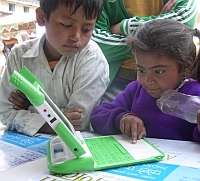
So when a colleague started telling me about the Give One, Get One laptop program, you can understand why I was a bit skeptical. How will giving students in developing nations a laptop change oppressive governmental regimes, unequal distribution of wealth, or lack of clean drinking water? And that’s when it hit me: laptop = literacy. I don’t mean literacy in terms of teaching a child to speak, write, or read English, Swahili, or French. Instead, the power in giving a child a laptop is that it helps that student become technologically literate. Yes, it will also increase her traditional literacies, but even more, a laptop connects that child to the world outside her immediate community.

Paulo Friere and Stanley Fish both wrote about this very idea: When you know the word for something, you own that thing. You have power over it. You can describe it, you can manipulate it, you can use it with conviction. Literacy equals power. The same principle applies to technology. A child with the knowledge of how to navigate the Internet has power. He or she is able to enter into the realm of the privileged class. Education is not just the playground of the elite when everyone has the opportunity to enter into the discussion.

And, so I encourage you to check out the One Laptop Per Child Project like I did. What a wonderful gift for the child in your life - each time your child connects to the Internet, you’ll know you’ve also helped to empower another child not so different from your own.

Sunday, November 18, 2007

Addictive Vocabulary

This is so addictive: Free Rice. I don't know if I should thank or curse the blogger at Epic Adventures are Often Uncomfortable for sharing this one.

Students check it out! Not only will you be testing your vocabulary knowledge, but you'll be helping the hungry as well.

Integrating Technology


Many of the sessions at this past week’s annual National Council for Teachers of English conference dealt with the integration of technology into the classroom. It was wonderful to hear how educators grappled with the question of when and how to use technology to promote critical engagement with their content. English teachers around the nation are finding creative ways to use technology to not only educate their students on new applications, but more importantly, to teach students problem-solving and critical thinking skills.

I learned about a number of new resources at a wonderful presentation on summer reading. Check out these great free resources:

For Wiki pages:
  • pbwiki.com is a free and easy site to use. It utilizes the basic format of Wikipedia and is very easy to navigate.

  • www.wikispaces.com is more robust than pbwiki. Also free, you have more control over design elements using Wikispaces.


  • For social bookmarking pages:
  • del.cio.us is a free social bookmarking page. What the heck is a social bookmark? The idea is that instead of saving all your bookmarked websites to one local computer, you save them to the del.cio.us web page. Doing so allows you (or any one that you give your del.cio.us web address to) access to your bookmarks from any computer that has web access. This is great tool as it allows educators to create a list of bookmarks for a particular assignment and have our students access the linked web pages in one location.

  • www.diigo.com takes the idea of social bookmarking one step further. This free site not only lets you save all your bookmarks to the web, it also allow you to leave "sticky notes" (a pop up page on the website you've bookmarked where you leave notes to yourself) that you or your students can access. It allows you to leave directions or notes for your students on the web pages that you want them to access.


  • For instant messaging:
  • www.meebo.com is an online interface that allows users to connect all IM applications. So whether a user is on Yahoo! IM or AIM, Meebo connects all instant message applications. I even learned about a school that was using IM for a summer reading assignment!


  • For video assignments:
  • The Flip digital video camera is new on the market. It is a video camera that can film up to 60 minutes of footage. But instead of fumbling with a million cords and software disks to upload movies to your computer, the Flip camera is equipped with a USB plug and the software already loaded to the camera. You can upload your video to any computer without having to install any extra applications, making video projects super easy.


  • For even more information, check out the presenters’ Wikipages at summerreadinncte.pbwiki.org/Technology.

    Thursday, November 15, 2007

    Instruction vs. Instructions


    That’s it. I’m moving to Canada - British Columbia to be exact. Listening to an engaging presentation by a group of teachers from Richmond, British Columbia, at today’s NCTE pre-conference sessions in New York, I’ve become convinced that British Columbia’s got the answer. Not only do teachers there have clear and specific standards guiding their curriculum, but they also have a province-wide testing program that is rooted in formative assessment. Teachers in British Columbia are encouraged to utilize assessment as a way to guide what and how they teach, instead of assessment being used against them based on how well their students perform (or don’t). Assessment is seen as a tool rather than a result. In fact, the presenters I heard today described a progressive grade reporting system in which their first quarter grades are descriptive (literal descriptions of student progress rather than letter grades) in order to give teachers an opportunity to get to know their students’ strengths and struggles and give students an opportunity to practice skills before receiving a mark. It is a system where students are given an opportunity to master concepts and skills and not simply manage them and move on. Students are encouraged to reflect on their learning, set goals, and practice concepts before they ever receive an official mark. What an idea! We measure what students learn instead of penalize them for what they haven’t.

    In actuality, today’s session reinforced a great deal of what I’m already trying in my own classroom – giving students an opportunity to receive peer and teacher feedback on their writing before turning it in for a grade, encouraging students to identify their strengths and struggles in order to set goals, and providing opportunities to retake assessments as a way to show mastery. Teaching in this way, we as teachers give up ownership of the classroom and turn it back over to the students. Such a change in focus encourages student reflection on learning, thereby engaging the individual student in his or her educational process.

    As a way to highlight this, the presenters displayed a wonderful quote from Kylene Beers’ book Why Kids Can’t Read which posed the question of whether we as teachers are spending our time on instruction or instructions. Do we spend our time as coaches and mentors, modeling instruction, or do we instead spend our time giving detailed instructions, hoping that the more we give, the more they’ll get it?

    For all that the presentation helped to reinforce, it also has me questioning the usefulness of some of what I do. I value formative assessment, using assessment as a tool for learning rather than simply an assessment of leaning; however, I’m guilty of giving instructions rather than being a tool for instruction. My students and I joke that I explain too much. I think of the overhead I left for my substitute today, loaded down with instructions. So while I firmly believe that formative assessment and teaching for mastery are crucial to student development and learning, I apparently still have a long way to go. So, since I have more to learn, maybe I should stick around before packing my bags and moving north. I guess Canada will have to wait.

    Friday, November 9, 2007

    For All They Know

    It still surprises me that very few of my students know how to use the “Track Changes” function in Word, or, for that matter, how to correctly add MLA headers to their essays using the “Header and Footer” option. Each semester, I am asked repeatedly to show students how to change the margins in Word, how to set tabs, and how to create tables. Apparently I am not alone. In his recent post on Sicheii Yazhi, Eric reflects on a similar phenomenon in his classroom:
    “If that’s the case for an “ancient” tool like the word processor, imagine the implications for wikis, blogs, and social networks. And that’s just the basic skills. Wanna lay odds on how much thought they’ve put into the effective and ethical use of those tools? How about moving beyond the tool and returning to critical analysis of the content, the interplay between content and form, or the connections to any content created more than five years ago?”

    With technology evolving so quickly, teachers often feel lost in a sea of acronyms and digital coding while our students surf on ahead of us. However, like Eric, I’ve found that most students know how to surf the web but not how to navigate it. Students know how to find basic answers quickly, but do not spend much time learning the specifics of using any one application to its fullest potential. They hit a wall, encounter a challenge, and instead of spending time dwelling with that problem, they turn to Google in hopes that someone else will give them the answer. We live in an age where, on the surface, problems can be dealt with quickly by plugging simple questions into Ask.com.

    I find this analogous to how students enter my classroom – they know how to read the words on the page, but do not spend much time critically analyzing the perspective presented or reflecting on the message behind the medium. As educators it is our job to help students decode the world around them, whether we are teaching our students about technology or how to understand a poem. We must teach students to slow down, to reflect and dwell on challenges. We must teach students problem solving skills because Google will not have the answers for the real problems they will face in life. As such, we can use the same teaching tools we have for years. Our goal as educators is not to learn every new technological trick. We don’t have to be experts in every new application available. Instead, we teach students how to become critical consumers of technology in the same ways that we teach them to be critical consumers of literature.

    Whew! What a relief because I just figured out last week what the heck the del.icio.us tag at the bottom of everyone’s blog was all about!

    Thursday, November 8, 2007

    I'm still at school and it is 5:30 p.m.

    A mentor once told me that teachers should never actually figure out what their time is worth – never divide your salary by the actual number of hours that you spend being a teacher. Looking back, I think this is rather misguided advice to give to a new teacher. The advice is foolish not because I think teachers should calculate their worth, but because no one goes into education to make money. Teachers do what they do because they love working with students – being a part of that moment when a student makes a connection to what you are teaching, when you’ve just witnessed a young person make a discovery that will potentially change the way she understands herself and the world she lives in. I love my job. How many people get to say they enjoy what they do each day. I wake up thankful (darn early, but thankful) that every day I can expect to be surprised.

    That said, this has definitely been one of my more difficult weeks. It is Thursday and I’ve been at school every day this week until a little after five, picking up after student presentations and preparing for the presentations that will happen the next day. When I arrive home, the book bag is hurled onto the couch, its contents spilling everywhere because the zipper can’t contain the student essays, projects, pen pal letters. I nestle into the worn cushions, piles of homework and quizzes form an arch around me and extend to the coffee table and floor. There I sit and grade until about 10.

    It was at about four o’clock this afternoon when I realized I had not stopped to eat either breakfast or lunch. I love that students are always in my classroom – before school, during lunch, and after school. It makes me feel like I’ve accomplished one of my goals of setting up a safe and inviting space for students to be. But I am occasionally (often) guilty of neglecting myself in order to take care of others. In fact, I think most teachers are guilty of this. In a conversation with a colleague the other day, we joked that both of our significant others find it exasperating how much of our time is taken up thinking about, planning for, preparing to, and evaluating our teaching. My husband will often arch a disapproving eyebrow in my direction when I tell him I’ve volunteered to sponsor another after school club or have spent part of my paycheck on more books for my classroom. But other teachers understand this. Teachers give of themselves, and not just part of who we are. Good teachers give themselves wholly to the art of teaching. Teaching is a labor of love.

    However, this is not to say that I think it admirable or wise to neglect oneself. In fact, I find when I do this, I am actually a worse teacher. When I take on extra duties or volunteer for another committee, I don’t have enough of myself left to give to teaching. On his blog So You Want to Teach, Joel confronts this same issue and has some great advice for avoiding the burnout that many teachers experience – “All Work and No Play...”. Read any teacher’s blog, listen in on any conversation between teachers, and you will hear about the struggles of juggling teaching and a life outside of teaching. I am worse at finding that balance now than when I first entered the classroom six years ago.

    But what makes it all worth it is that moment when you know a young person got it – that “ah ha!” moment. So I will grade until 10 tonight, I will get up early, I will not calculate my time because I live for those moments.

    Related Posts: