Showing posts with label Motivation. Show all posts

Saturday, March 1, 2014

What is Heutagogy?

I learned a new word just a few days ago: heutagogy. But before I explain what it means, I want to backtrack and explain how I learned about the idea of heutagogy.

My 10th grade students collaborating
My tenth grade students completed 20% time research projects during the fall semester. This was a change from the type of research they had completed in earlier classes in that I encouraged them to select topics they did not ordinarily have an opportunity to learn about in class, and we used at least (sometimes more) one full class day each week as a workshop day to research, read, interview, create, and revise their writing and their thinking. But it also meant that my students completed a lot of research in the fall. Not only did my students complete a 20% time project, but they also completed the more traditional research paper on an issue presented in a literary text that is currently mandated as part of our core curriculum. I sought permission from my principal to pilot this new approach to teaching research after completing a MOOC with A.J. Juliani this past summer. And as students completed their research, I was also starting my own, collecting examples of student work, watching how students engaged in the research process and used class time, reviewing the reflection blogs students posted about their process and what they were learning. Now that my students are established in their second semester classes, I have an opportunity to reflect on the process we engaged in and the skills students developed as they worked toward the completion of their self-selected and self-directed research. Having a bit of distance from the completion of their 20% time research project, I wonder what students will say about what and how they learned. Although I know why I feel such learning expereinces are valuable to their critical thinking and writing development, I need to hear from my students.

So this past week I had some information conversations with my former students. When I asked students what they thought about the 20% research project, four of the five students I spoke with responded that they like the opportunity to learn something that they usually did not get to study in school or that they liked being able to select their own topic without having to chose from a list. One of the students responded that he liked that he could learn in depth about a topic of his choice. Another student liked that she could choose the way in which she shared what she learned and with whom she shared it. So, the idea of choice has started to guide some of my initial research.

Graphic found on the NCSL's site
I started to look through some of the research on writing that I already had gathered. In trying to find published research on teachers doing 20%time/Genius Hour projects, I stumbled upon a recent blog post mentioned on Cybrary Man’s web resource for Genius Hour/ 20% Time. I was intrigued because he recently retitled this resource to included Self-Determined Learning. I have never heard of this before, although it seems evident. The blog post that prompted Cybrary Man’s page name change was a piece by the American School of Bombay Research and Development team and called for an end to Genius Hour and 20% Time Research projects. The reason? Such "projects" are relegating what many think of as the most meaningful work that we are doing in our classrooms to one hour or one class period a week, putting a box around this type of learning rather than thinking about what it means for our curriculums as a whole. I was intrigued by this idea. The post mentioned the work being done by Richard Ryans and Edward Deci on Self-Determined Learning (SDL). And within a few clicks and a quick perusal of Daniel Pink’s book Drive, I realized that I had already read a little bit of their work. Not only was Ryan and Deci’s work was mentioned in Drive, but their work is also being used to support a new movement - Heutagogy.

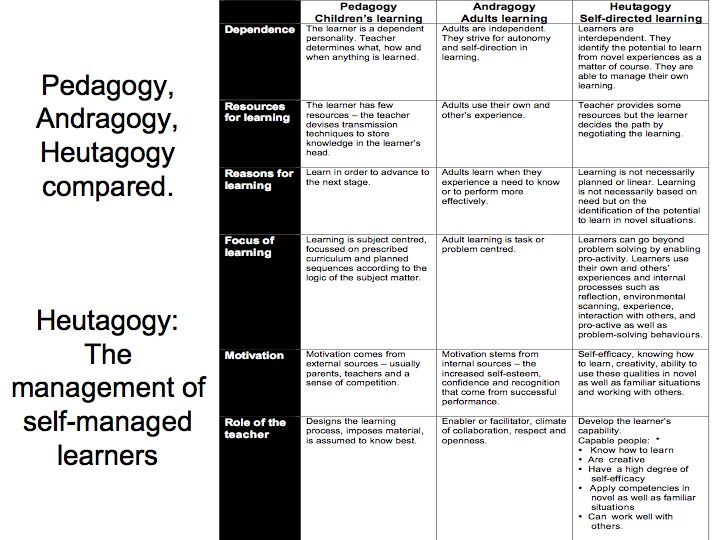
Click to view the larger size of Lindy McKeown Orwin's image at TeachThought
Heutagogy seems to have gotten its start in the 1970s by looking at what motivates adult learners, although initially this approach was called andragogy. Heutagogy is a evolution of some of that earlier research on what motivates learning, but heutagogy also includes an educational mandate. Instead of simply examining how people learn, heutagogy is also a focus on metacognition, getting students and teachers to think about how they learned what they learned. Hase and Kenyon are thought to be the originators of this approach, which they outline in a piece called “From Andragogy to Heutagogy”. This approach is also often called self-determined or self-driven learning. A quick search of #heutagogy on Twitter revealed that in the last month, more and more educators are starting to use this term and ideas of choice, autonomy, and mastery as they discuss successful learning and writing projects.

As I learn more about the tenets of heutagogy, I see this as being a framework for my research on my students' engagement in their 20% time research project.

I wonder if other educators are also using heutagogy in the development of their curriculum.  I would love to hear from you!


Tuesday, November 10, 2009

Motivate Me?

I finished my application and video for the upcoming Google Teacher Academy. Just in time, too. It was due by midnight last night. I submitted mine at 11:30 pm. Those that know me, know that this if fairly typical. I realized a long time ago that my procrastination acts as a bit of a defense mechanism. If I fail, I have a built in excuse - I should have failed. I didn't give myself enough time. It takes the pressure off. If I succeed, well, it is a happy bit of coincidence. However, my husband's voice has been ringing in my head recently, asking me to spend some time reflecting on this bad habit. Frustrated with my procrastination, he asked me to imagine what I could accomplish if I gave myself and my endeavors the time they deserve. But once again, I found myself leaving my work to nearly the last minute. Perhaps, I'm just not motivated.

Coincidentally, motivation was the theme of the video I put together for my Google application. Applicants were asked to put together a one minute video on either Innovation and Teaching or on Learning and Motivation. I decided to focus on motivation.

Surprisingly enough, I did start my application long before last night. A few weeks ago, I put together a survey and asked my students to think about what motivated them to learn. I shared a link to that survey with high school students around the world via my Twitter PLN. As of today, I've heard from 66 students from Pennsylvania, Oregon, and China. I also went searching through my bookcases. What had others written about motivation? And between the students' responses and what others have written, he here's what I discovered:

I hate the word motivation.

When educators use this word, it is usually in the form of - "What can we do to motivate our students?" Translation: "What can we do to force our students to do what we want them to do?" Motivation is the wrong word. Reading through the plethora of educational philosophy texts on motivation and countless education blogs, I feel that what most educators are concerned with is coercion. Not motivation. And it is no wonder. With the public and the government knocking down the doors of our schools, clamoring on about standards and grades and outcomes, teachers are in a mad dash to force our students into compliance. In fact, in Pennsylvania that seems to be the language we are using to talk about how schools have performed on state mandated exams - are schools in compliance? When did learning become about compliance?

So I found myself flipping back through the works of writers like Alfie Kohn, Paulo Freire, and John Dewey last night. And I am reminded that real learning is often times undermined by the attempt to quantify it. Alfie Kohn writes in Punished by Rewards: The Trouble with Gold Stars, Incentive Plans, A's, Praise, and Other Bribes,
"We want students to become rigorous thinkers, accomplished readers and writers and problem solvers who can make connections and distinctions between ideas. But the most reliable guide to a process that is promoting these things is not grades or test scores: it is the student's level of interest" (146).
In fact, we know this about even our tiniest learners. The best predictor for intelligence in toddlers is not how well or how fast they learn particular actions or achieve set milestones. Instead, one of the predictors for intelligence is a child's curiosity and interest in exploring his environment. An intelligent child is the interested child. And children want to learn. Kohn goes on to write,
"...children do not need to be motivated. From the beginning they are hungry to make sense of their world. Given an environment in which they don't feel controlled and in which they are encouraged to think about what they are doing (rather than how well they are doing it), students of any age will generally exhibit an abundance of motivation and a healthy appetite for challenge" (198-9).
I know this to be true. I see it daily in my son.

He eats up the world. Gathers it in his tiny hands, rolls it over, considers it carefully. I do not have to "motivate" him to try new things, to learn. He is curious, ready to experience the world on his own. And when I try to force him to practice this or that milestone, let's try walking today, he resists. But he will pull himself up on anything and everything, cruise along any piece of furniture that is just over two foot tall. I do not grade his progress. I do not "motivate" his learning with some intangible reward. Instead, I set him in the middle of the floor with books and shiny objects, with new toys and old, and let him discover what something is, how it works, and how he can manipulate it. I facilitate his learning by creating a learning environment. Which is what as a teacher, I should be doing in my classroom.

Kohn writes,
"The job of educators is neither to make students motivated nor to sit passively; it is to set up the conditions that make learning possible. The challenge...is not to wait 'until an individual is interest...[but to offer] a stimulating environment that can be perceived by students as [presenting] vivid and valued options which can lead to successful learning and performance'" (199).

I am a facilitator of learning, not a dictator of knowledge. I do not motivate learning. I facilitate it.

Thursday, November 5, 2009

What Motivates Learning?

I'm motivated to learn more about motivation.

What motivates students to learn, to engage in our content, to apply their knowledge in unique and meaningful ways? Are you a high school student? Help me learn more about what motivates learning. I'm asking high school students to take a moment to complete this quick survey. You'll be able to see a summary of the results after you submit your completed survey. I'll then compile the results, share them here in a blog post, and use them to inform how I teach. And hopefully, as other educators access this site, it will start a conversation about how, what, and why we teach what we teach.

CLICK HERE for the survey.

Related Posts: